

How AI Is Transforming Private Aviation — and What the SpaceX IPO Tells Us About What's Next

How AI Is Transforming Private Aviation in 2026
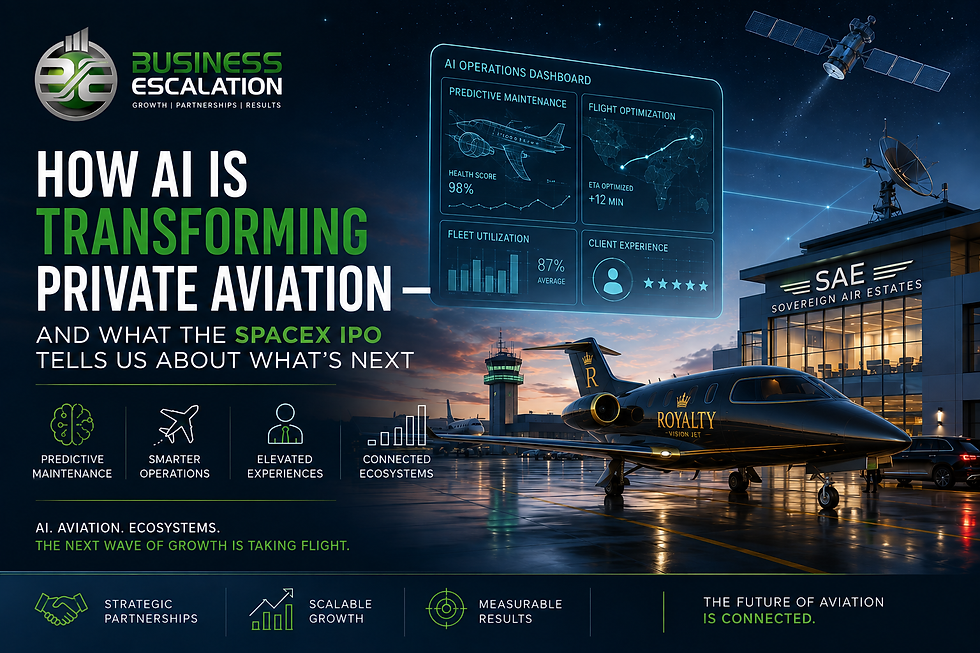
This week, SpaceX prices the largest IPO in market history — roughly a $1.75 trillion valuation, with shares set to begin trading June 12 on Nasdaq. Whatever happens to the stock, the bigger story for the rest of us isn't the rocket company. It's where all that capital and attention flows next. And one of the clearest beneficiaries is AI in private aviation — an industry quietly being rebuilt around prediction, automation, and data.
If you own aircraft, run an FBO, train pilots, or invest in the space, the question worth asking isn't whether AI will change private aviation. It already is. The real question is who's positioned to capture it.
Why this is the moment everyone's watching
Big public listings don't just raise money for one company — they re-rate an entire sector. When billions of dollars and a wave of investor attention pour into aerospace, the spillover lands on the adjacent industries: aviation services, flight operations, maintenance, infrastructure, and the technology layer connecting them.
We saw the same pattern before. The early internet boom didn't just reward search engines — it built the cloud-computing industry underneath them. The smartphone didn't just sell phones — it created the app economy. A landmark aerospace IPO works the same way: the loudest headline is the rocket, but the durable opportunity is in the ecosystem that grows around it. For private aviation, that ecosystem is being reshaped right now by artificial intelligence.
Where AI is actually changing private aviation today
Skip the buzzwords — here's where AI is already doing real work in private and business aviation:
Predictive maintenance. Instead of servicing aircraft on fixed schedules, operators now use sensor data and machine-learning models to predict component failures before they happen. The payoff is fewer surprise groundings and lower downtime — the single biggest cost in any aviation operation.
Flight operations and routing. AI systems weigh weather, fuel pricing, slot availability, and crew constraints to optimize routes and turnarounds in real time — decisions that used to take dispatchers hours and a lot of guesswork.
Concierge and client experience. In private aviation, the product is the experience. AI is starting to power the booking, ground coordination, and personalization that high-end travelers expect, connecting jet, car, catering, and crew into one seamless handoff.
Asset and fleet management. Owners and operators increasingly want a live view of where every asset is, what it costs, and how it's utilized. AI turns scattered operational data into that single picture.
None of this is futuristic. It's deployed today. What's still up for grabs is which operators integrate it well — and that's where the next decade's winners separate from the pack.

The second-order opportunity: the ecosystem, not the aircraft
Here's the part most people miss. The aircraft is the asset everyone looks at. The value increasingly lives in the connective tissue around it.
A private flight touches a dozen businesses: the FBO, the maintenance shop, the flight school that trained the crew, the concierge service, the charter broker, the insurer, the financier. Historically these have all operated as separate silos, each with its own systems and its own friction. The organization that can intelligently connect those stakeholders — sharing data, coordinating in real time, removing friction at every handoff — captures value that no single operator can on its own.
That's the genuine opportunity the SpaceX moment is shining a light on. Not "buy aerospace stock," but: the aviation ecosystem is fragmented, AI is the tool that finally connects it, and the capital to build that connective layer is arriving now.
What this means if you're positioning now
The companies that thrive over the next decade in aviation probably aren't the biggest operators today. They're the ones that recognize this shift early and build for the connected, AI-enabled model before it becomes the default.
That's the thinking behind Sovereign Air Estates and the Royalty Aviation DAO— an early-stage concept exploring how luxury aviation, concierge services, and a shared digital layer can link aircraft owners, service providers, travelers, and partners into one connected ecosystem rather than a set of disconnected vendors.
It's also where Business Escalation works: helping operators, startups, and investors in this space identify where the growth actually sits, structure the right partnerships, and build the infrastructure to capture it. Growth in aviation rarely comes from effort alone — it comes when structure, partnerships, and execution line up against a trend that's already moving.
The SpaceX IPO will dominate headlines this week and be forgotten in a month. The shift it points to — AI rebuilding private aviation from the operations up — is just getting started.
Business Escalation helps entrepreneurs and established organizations identify growth constraints, develop strategic partnerships, and build scalable infrastructure for long-term success. [Get in touch] to talk through where you fit in the next wave of aviation and AI.


Comments